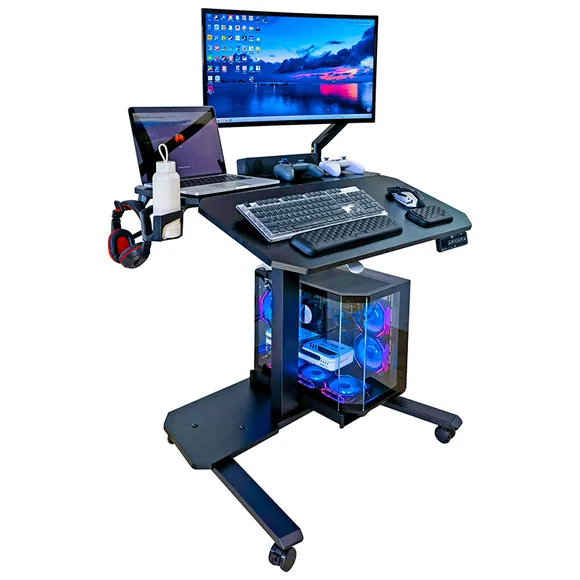
Most buyers who start sourcing hong kong standing desk online end up comparing photographs. Photographs do not tell you whether the frame will still be square after two thousand sit-to-stand cycles, whether the control box survives a brownout, or whether the factory can repeat the same finish six months later. Those three questions decide whether a container arrives as sellable stock or as a warehouse problem.
This guide is written for procurement teams, distributors and contract furnishers who need a repeatable supply source rather than a one-off deal. It covers what to verify before a deposit, how the specifications should be written, and which documents a serious factory should hand over without being asked twice.
Seeing the mechanism before you commit a container budget removes most of the risk. These clips are shot on our own line, not stock footage.
Full gallery: cheukhamfurniture.com/videos.html
Removing a trading layer does not automatically reduce the landed cost, because freight, duty and compliance are unchanged. What it does change is where the money goes. The same ex-works price can buy a thicker leg tube, a better control box, or a proper carton with edge protection instead of a thin box that arrives crushed.
For a distributor buying hong kong standing desk in container quantities, the difference between a 1.2mm and a 1.5mm leg wall is a few dollars per unit. The difference in stability at full height is immediately visible in a showroom. That is the trade a direct buyer can make deliberately, instead of inheriting whatever the intermediary negotiated.
The second economic effect is speed on repeat orders. Once the specification and the artwork are on file at the plant, a repeat run can be scheduled without re-confirming every detail, which shortens the cash conversion cycle for the distributor.
A purchase order for hong kong standing desk should read like a specification, not a shopping list. Start with the frame: stage count, tube wall, stroke length, and the height range measured without the top. Then the electronics: motor model, control box, handset type, memory presets, and the anti-collision behaviour. Then the finish: process, colour reference, and the acceptable gloss range.
Add the packaging section. Carton grade, foam or moulded pulp, edge protection, pallet pattern, and the number of units per pallet. Packaging disputes are the most common cause of a claim that nobody can resolve, because the original agreement never described the carton.
Finally, write the acceptance rule. State the sample size, the AQL level, and who pays for re-inspection if the lot fails. A factory that quotes against a written acceptance rule will price the work honestly; one that quotes against a sentence will price the sentence and deliver something else.
Keep the signed sample. It is the only artefact that settles a colour or feel argument six months later.
| Parameter | Compact | Standard | Premium |
|---|---|---|---|
| Frame stages | 2-stage / 3-stage | 3-stage | 3-stage |
| Height range (without top) | 710-1190 mm | 620-1270 mm | 580-1230 mm |
| Load capacity | 80 kg | 120 kg | 100 kg |
| Leg tube wall | 1.2 mm | 1.5 mm | 1.5 mm |
| Motor | single | dual | dual |
| Noise at rated load | <50 dB | <48 dB | <48 dB |
| Handset | up/down | 4 presets + reminder | 4 presets + USB |
| Anti-collision | optional | standard | standard |
The table is a starting point for an RFQ, not a catalogue promise. Final values depend on the frame you select and the top you specify. Ask for the drawing that matches your order.
Before releasing the balance, collect four things: the signed inspection report for the lot, the packing list reconciled against the purchase order, the certificate of origin if the destination requires it, and photographs of the loaded container with the seal number visible. These are routine requests. A supplier who treats them as unusual is signalling that the process is not routine.
Keep the CE or UKCA declaration and the RoHS report on file with the same lot reference. If a customer or a market surveillance authority asks a question two years later, the answer should be retrievable in minutes, not reconstructed from email.
Finally, confirm in writing who handles a warranty claim and what the response time is. The answer should name a person and an address, not a general inbox.
A quoted lead time is only meaningful when the start point is defined. Ask whether the clock starts at deposit, at artwork approval, or at material arrival. For a repeat model with stock motors, 25 to 35 days from deposit is realistic. For a new powder colour, add the coating line's changeover and the cure verification.
Freight to Hong Kong is short, but the local leg still needs booking. A distributor who plans a launch date should work backwards from the delivery date, not forwards from the order date.
Ask for a production schedule with the key gates: material in, frame welded, coated, assembled, tested, packed. A factory that can share this schedule is managing the order; one that cannot is hoping.
One pallet per SKU is the practical minimum, typically 30 to 60 units. Below that the packing and setup cost dominates, and the factory cannot hold a custom specification economically. For a first order, a mixed container with three or four models is the usual structure.
Yes. Logo printing on the handset, a label on the frame and a printed carton are all routine. Artwork must be approved before production, and the first article should be photographed against the approved artwork. Keep the approved artwork file with the purchase order so a repeat order cannot drift.
Production is 25 to 35 days for a repeat model and 35 to 45 days for a new colour or modified frame, counted from deposit and artwork approval. The sea leg to Kwai Chung is short, and local clearance and delivery usually add about a week.
The frame and the motor system are covered separately because they fail differently. A written statement should name the covered period for each, the claim path and the response time. Ask for it before the deposit, and keep it with the batch record so a claim can be matched to the lot.
If you are building a hong kong standing desk programme for Hong Kong, Europe or North America, send the specification you have, even if it is incomplete. We will return a quotation with the motor and control box identified, the packaging described, and the lead time counted from a defined start point.
Email 23842190@qq.com or message WhatsApp +86 139 2918 1689. Factory address: Longjiang Town, Shunde District, Foshan, Guangdong, China. Browse the full range at our product catalogue.
We are the manufacturer — send us your specs and get a factory-direct answer within 24 hours.
Contact CHEUKHAM →