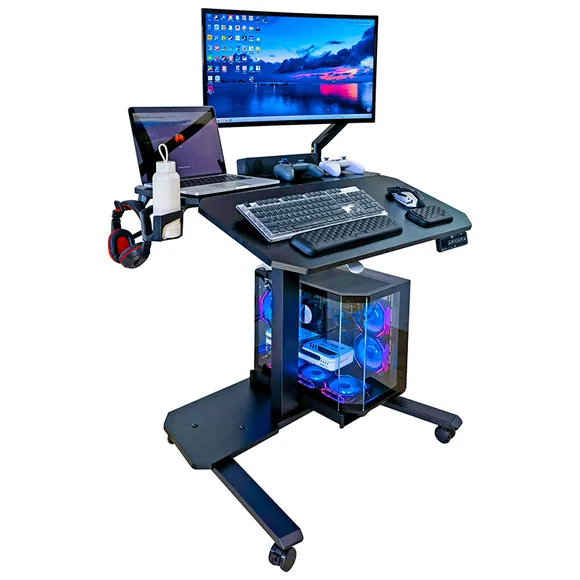
Direct factory sourcing only works when the buyer keeps control of the specification. If the purchase order says "electric standing desk, black, 1400mm" then the factory is free to choose the motor, the control box, the leg wall thickness and the coating process. Every one of those choices is a cost lever, and a supplier under price pressure will pull all four.
This article turns a loose enquiry into a controlled specification for contract furniture supplier. It is structured so that a procurement officer can copy the sections directly into an RFQ, and so that a factory engineer can quote against them without guessing.
Foshan and the surrounding Pearl River Delta cluster supplies a large share of the world's height-adjustable desk frames. The advantage is not simply a lower hourly rate. It is the density of the supply chain: motor houses, control box assemblers, powder coating lines, laser tube cutters and hardware platers sit within a short drive of each other. A factory in that cluster can change a leg profile or add a cable tray without waiting six weeks for a new tooling supplier.
That density also makes quality visible. A buyer can ask for the motor supplier's model number and cross-check it against the same unit used by European brands. In a region with only one motor source, that comparison is impossible and the buyer is effectively trusting a brochure.
Working direct also removes a margin layer that usually buys nothing at the factory gate. A trading company adds coordination, but the physical product, the QC record and the warranty exposure all still come from the same plant. When the buyer talks to the plant, the corrective action loop is shorter.
A purchase order for contract furniture supplier should read like a specification, not a shopping list. Start with the frame: stage count, tube wall, stroke length, and the height range measured without the top. Then the electronics: motor model, control box, handset type, memory presets, and the anti-collision behaviour. Then the finish: process, colour reference, and the acceptable gloss range.
Add the packaging section. Carton grade, foam or moulded pulp, edge protection, pallet pattern, and the number of units per pallet. Packaging disputes are the most common cause of a claim that nobody can resolve, because the original agreement never described the carton.
Finally, write the acceptance rule. State the sample size, the AQL level, and who pays for re-inspection if the lot fails. A factory that quotes against a written acceptance rule will price the work honestly; one that quotes against a sentence will price the sentence and deliver something else.
Keep the signed sample. It is the only artefact that settles a colour or feel argument six months later.
| Parameter | Compact | Standard | Premium |
|---|---|---|---|
| Frame stages | 2-stage / 3-stage | 3-stage | 3-stage |
| Height range (without top) | 710-1190 mm | 620-1270 mm | 580-1230 mm |
| Load capacity | 80 kg | 120 kg | 100 kg |
| Leg tube wall | 1.2 mm | 1.5 mm | 1.5 mm |
| Motor | single | dual | dual |
| Noise at rated load | <50 dB | <48 dB | <48 dB |
| Handset | up/down | 4 presets + reminder | 4 presets + USB |
| Anti-collision | optional | standard | standard |
The table is a starting point for an RFQ, not a catalogue promise. Final values depend on the frame you select and the top you specify. Ask for the drawing that matches your order.
Before releasing the balance, collect four things: the signed inspection report for the lot, the packing list reconciled against the purchase order, the certificate of origin if the destination requires it, and photographs of the loaded container with the seal number visible. These are routine requests. A supplier who treats them as unusual is signalling that the process is not routine.
Keep the CE or UKCA declaration and the RoHS report on file with the same lot reference. If a customer or a market surveillance authority asks a question two years later, the answer should be retrievable in minutes, not reconstructed from email.
Finally, confirm in writing who handles a warranty claim and what the response time is. The answer should name a person and an address, not a general inbox.
The first order should be small enough to test the relationship and large enough to be economically sensible. A single 40HQ mixed with three or four models is the usual compromise. It gives the distributor a full showroom story without committing to a full container of one SKU.
Build the order around one hero model that carries the brand message and two or three volume models that fill the price ladder. Keep the accessories, such as cable trays and monitor arms, in the same shipment so the showroom can demonstrate a complete workstation.
For contract furniture supplier shipped to Hong Kong, allow one week for local clearance and delivery on top of the production lead time. If the goods are going into a project with a fixed handover date, book the production slot before the artwork is finalised, and hold the artwork approval as the only gate.
One pallet per SKU is the practical minimum, typically 30 to 60 units. Below that the packing and setup cost dominates, and the factory cannot hold a custom specification economically. For a first order, a mixed container with three or four models is the usual structure.
Yes. Logo printing on the handset, a label on the frame and a printed carton are all routine. Artwork must be approved before production, and the first article should be photographed against the approved artwork. Keep the approved artwork file with the purchase order so a repeat order cannot drift.
Production is 25 to 35 days for a repeat model and 35 to 45 days for a new colour or modified frame, counted from deposit and artwork approval. The sea leg to Kwai Chung is short, and local clearance and delivery usually add about a week.
The frame and the motor system are covered separately because they fail differently. A written statement should name the covered period for each, the claim path and the response time. Ask for it before the deposit, and keep it with the batch record so a claim can be matched to the lot.
If you are building a contract furniture supplier programme for Hong Kong, Europe or North America, send the specification you have, even if it is incomplete. We will return a quotation with the motor and control box identified, the packaging described, and the lead time counted from a defined start point.
Email 23842190@qq.com or message WhatsApp +86 139 2918 1689. Factory address: Longjiang Town, Shunde District, Foshan, Guangdong, China. Browse the full range at our product catalogue.
We are the manufacturer — send us your specs and get a factory-direct answer within 24 hours.
Contact CHEUKHAM →