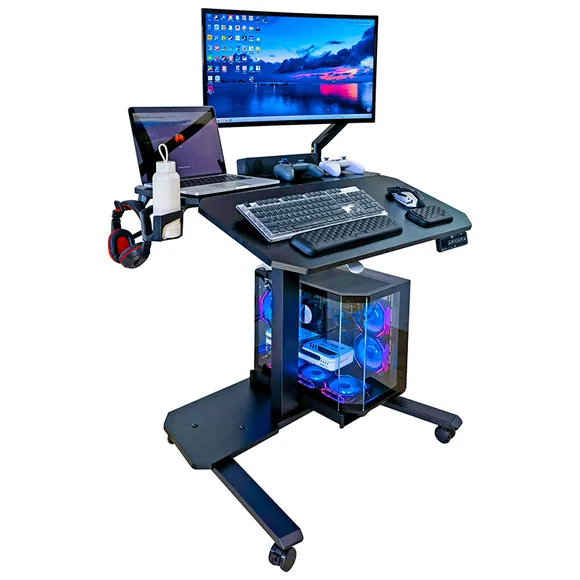
A standing desk programme fails for boring reasons. A motor batch runs hot, a powder coat shifts half a shade, a controller firmware revision changes the height memory behaviour, and suddenly the same SKU is three different products across three containers. Buyers usually discover this after the first mixed pallet reaches the showroom floor.
The purpose of this page is to shorten that learning curve. Below is the checklist our own export team uses when a new distributor asks for standing desk factory videos: what to confirm in the sample stage, what belongs in the purchase order, and what evidence should exist before the balance payment leaves your account.
Foshan and the surrounding Pearl River Delta cluster supplies a large share of the world's height-adjustable desk frames. The advantage is not simply a lower hourly rate. It is the density of the supply chain: motor houses, control box assemblers, powder coating lines, laser tube cutters and hardware platers sit within a short drive of each other. A factory in that cluster can change a leg profile or add a cable tray without waiting six weeks for a new tooling supplier.
That density also makes quality visible. A buyer can ask for the motor supplier's model number and cross-check it against the same unit used by European brands. In a region with only one motor source, that comparison is impossible and the buyer is effectively trusting a brochure.
Working direct also removes a margin layer that usually buys nothing at the factory gate. A trading company adds coordination, but the physical product, the QC record and the warranty exposure all still come from the same plant. When the buyer talks to the plant, the corrective action loop is shorter.
Buyers lose money in a predictable order: first on an underspecified sample, then on an unverified motor batch, then on packaging that was never drop-tested. Reversing that order is the cheapest improvement available.
Begin with a pre-production sample built on the production line, not in the sample room. Ask for the serial numbers of the motor and control box fitted to that sample, and keep the photograph of the labels. When the mass-production units arrive, spot-check that the labels match.
Next, witness or commission a cycle test on the actual batch. A desk that reaches the promised cycle count on a test rig in the factory is a different claim from a datasheet figure. Finally, inspect the carton before it is sealed, and drop one carton from the agreed height in front of the inspector.
None of this requires a third-party laboratory. It requires a buyer who writes down what will be checked, and a factory that expects the check.
| Parameter | Compact | Standard | Premium |
|---|---|---|---|
| Frame stages | 2-stage / 3-stage | 3-stage | 3-stage |
| Height range (without top) | 710-1190 mm | 620-1270 mm | 580-1230 mm |
| Load capacity | 80 kg | 120 kg | 100 kg |
| Leg tube wall | 1.2 mm | 1.5 mm | 1.5 mm |
| Motor | single | dual | dual |
| Noise at rated load | <50 dB | <48 dB | <48 dB |
| Handset | up/down | 4 presets + reminder | 4 presets + USB |
| Anti-collision | optional | standard | standard |
The table is a starting point for an RFQ, not a catalogue promise. Final values depend on the frame you select and the top you specify. Ask for the drawing that matches your order.
Before releasing the balance, collect four things: the signed inspection report for the lot, the packing list reconciled against the purchase order, the certificate of origin if the destination requires it, and photographs of the loaded container with the seal number visible. These are routine requests. A supplier who treats them as unusual is signalling that the process is not routine.
Keep the CE or UKCA declaration and the RoHS report on file with the same lot reference. If a customer or a market surveillance authority asks a question two years later, the answer should be retrievable in minutes, not reconstructed from email.
Finally, confirm in writing who handles a warranty claim and what the response time is. The answer should name a person and an address, not a general inbox.
A quoted lead time is only meaningful when the start point is defined. Ask whether the clock starts at deposit, at artwork approval, or at material arrival. For a repeat model with stock motors, 25 to 35 days from deposit is realistic. For a new powder colour, add the coating line's changeover and the cure verification.
Freight to Hong Kong is short, but the local leg still needs booking. A distributor who plans a launch date should work backwards from the delivery date, not forwards from the order date.
Ask for a production schedule with the key gates: material in, frame welded, coated, assembled, tested, packed. A factory that can share this schedule is managing the order; one that cannot is hoping.
One pallet per SKU is the practical minimum, typically 30 to 60 units. Below that the packing and setup cost dominates, and the factory cannot hold a custom specification economically. For a first order, a mixed container with three or four models is the usual structure.
Yes. Logo printing on the handset, a label on the frame and a printed carton are all routine. Artwork must be approved before production, and the first article should be photographed against the approved artwork. Keep the approved artwork file with the purchase order so a repeat order cannot drift.
Production is 25 to 35 days for a repeat model and 35 to 45 days for a new colour or modified frame, counted from deposit and artwork approval. The sea leg to Kwai Chung is short, and local clearance and delivery usually add about a week.
The frame and the motor system are covered separately because they fail differently. A written statement should name the covered period for each, the claim path and the response time. Ask for it before the deposit, and keep it with the batch record so a claim can be matched to the lot.
If you are building a standing desk factory videos programme for Hong Kong, Europe or North America, send the specification you have, even if it is incomplete. We will return a quotation with the motor and control box identified, the packaging described, and the lead time counted from a defined start point.
Email 23842190@qq.com or message WhatsApp +86 139 2918 1689. Factory address: Longjiang Town, Shunde District, Foshan, Guangdong, China. Browse the full range at our product catalogue.
We are the manufacturer — send us your specs and get a factory-direct answer within 24 hours.
Contact CHEUKHAM →